


About: Sayan Sircar (BE/MBA/CFA/FRM) has over 19 years of experience in goal-based investments, portfolio construction, risk/reward simulations and performance analysis. You can read more from Sayan here.
Summary
- The final deadline for Advance Tax for FY 2025-26 is March 15th
- Calculating tax on multiple mutual fund sells is complex due to FIFO and varying tax rates
- Moneyantra provides a free, automated tool to calculate your exact advance tax liability for your mutual fund portfolio
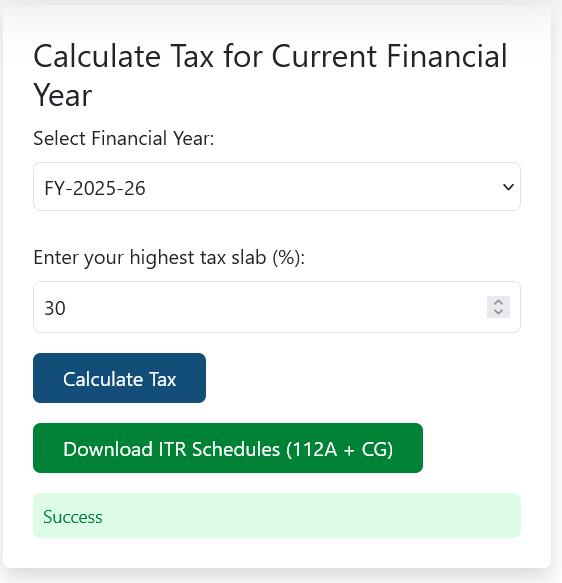
Calculate Advance Tax in Seconds 👇
Upload CAS into Moneyantra & Calculate Tax →What is Advance Tax and Who Needs to Pay It?
If you have sold capital assets like mutual funds, shares, property or have income like rent, dividends etc., which are not captured in your salary tax deduction, then you need to pay advance tax. This advance tax is payable on income between 1st April 2025 to 31st March 2026 and must be paid for FY 2025-26 based on this schedule:
| Due date | Advance tax payable |
|---|---|
| 15th June | 15% |
| 15th September | 45% |
| 15th December | 75% |
| 15th March | 100% |
In each of the above cases, you need to subtract the advance tax already paid. Advance tax is due if your total tax this year, after all TDS, is more than ₹10,000.
If you don’t pay this advance tax as per these dates, then two problems happen:
- Section 234C: You are charged 1% interest per month on the unpaid tax
- Section 234B: if you did not pay at least 90% of the advance tax by 31st March 2026, then an additional 1% interest per month is due from 1st April 2026 until you finally pay the tax
These penalties can very quickly erode the 12-15% returns from your funds if the tax is not paid on time.
How To Calculate Capital Gains Tax for Mutual Funds?
Capital Gains Tax calculation depends on the type of assets inside the fund, specifically on how much domestic equity (shares) is held in the fund:
| Fund Type | Equity Exposure | LTCG eligible | STCG Rate | LTCG Rate |
|---|---|---|---|---|
| Equity-Oriented | ≥ 65% | > 12 Months | 20% | 12.5% (112A Exemption ≤ ₹1.25L) |
| Hybrid / Others | 35% to 65% | > 24 Months | Slab Rate | 12.5% (No Exemption) |
| Specified (Debt) bought ≥ 01-Apr-23 |
≤ 35% | N/A | Slab Rate | Slab Rate (Always STCG under Sec 50AA) |
| Specified (Debt) bought < 01-Apr-23 |
≤ 35% | > 24 Months | Slab Rate | 12.5% (No indexation) |
Capital gains tax is of two types:
- Short-term Capital Gains (STCG) Tax
- Long-term Capital Gains (LTCG) Tax
To calculate capital gains tax, you need to find the oldest units as per the purchase date, which are considered sold as per the “First In, First Out” or FIFO rule. For each SIP / SWP / lump-sum (buy/sell) transaction date, the tax is calculated separately inside a particular folio.
If there is a loss, it is called a capital loss. Capital Loss occurs if the selling price is lower than the buying price and can be offset from income, like this:
| Capital Loss (CL) |
Offset against STCG? |
Offset against LTCG? |
|---|---|---|
| Short-term (STCL) |
✅ Yes | ✅ Yes |
| Long-term (LTCL) |
❌ No | ✅ Yes |
Any capital loss (either long-term or short-term) not offset this financial year can be carried forward for 8 years by filing an income tax return on time.
Doing this by hand or via Excel can be complicated, error prone and time-consuming. This is why we built Moneyantra’s free tax calculator, which does all of this in seconds.
Why not get the Capital Gains Summary from CAMS and KFintech?
CAMs and KFintech do provide a capital gains summary. However, they provide the summary only for their own serviced funds, which means that you need to generate the reports separately from both CAMS and KFintech to cover all of your funds and then combine them manually by yourself.
However, their reports are incomplete since they do not provide the tax due but instead stop after providing just the capital gains amount. This is the snippet from the KFintech capital gains report for my own transactions:
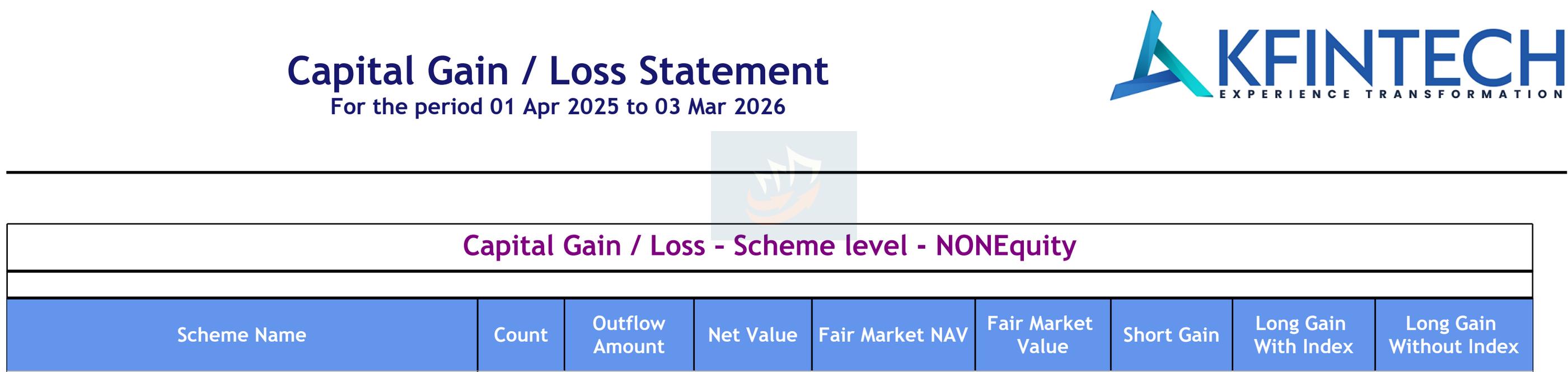
As you can see, this information does not actually tell you how much tax is due, how to apply Section 112A (LTCG ₹1.25 offset for eligible funds), and how to apply capital loss offsets.
The effort required to download the capital gains statement from either CAMS or KFintech is the same as the effort required to generate the complete consolidated account statement (CAS) from CAMS just once and using Moneyantra, get the complete tax report at one shot. Of course, Moneyantra offers much more than a capital gains report.
The same CAS that you will upload gives you:
- a daily updated dashboard of your holdings, asset allocation, investment, profit, loss and XIRR
- a way to calculate taxes on your mutual fund portfolio before you actually sell them via the Moneyantra capital gains tax simulation tool
- how to do tax harvesting to save ₹15,625 tax yearly by making use of the ₹1.25 lakhs LTCG exemption under Section 112A. We have a detailed article on this topic: How Indian Investors Can Legally Save ₹15,625 in LTCG Tax Every Year
- how to switch from regular funds to direct funds by knowing which funds to sell and the tax impact of selling
- get an automated mutual fund review report in PDF format into your mailbox in seconds, analysing your complete holdings and fund-level performance
What does Moneyantra provide in the Capital Gains Report?
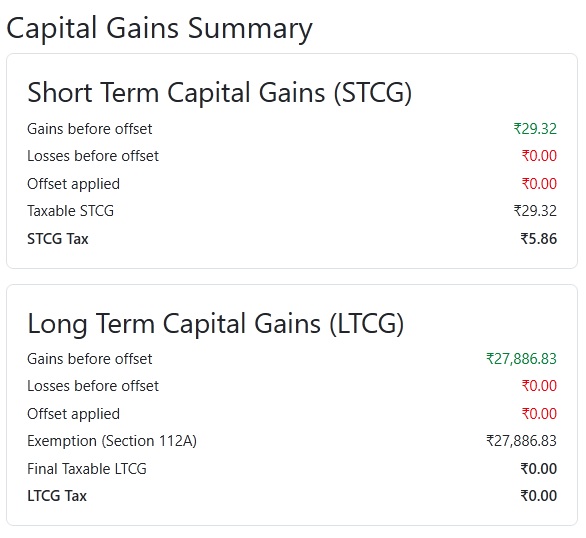
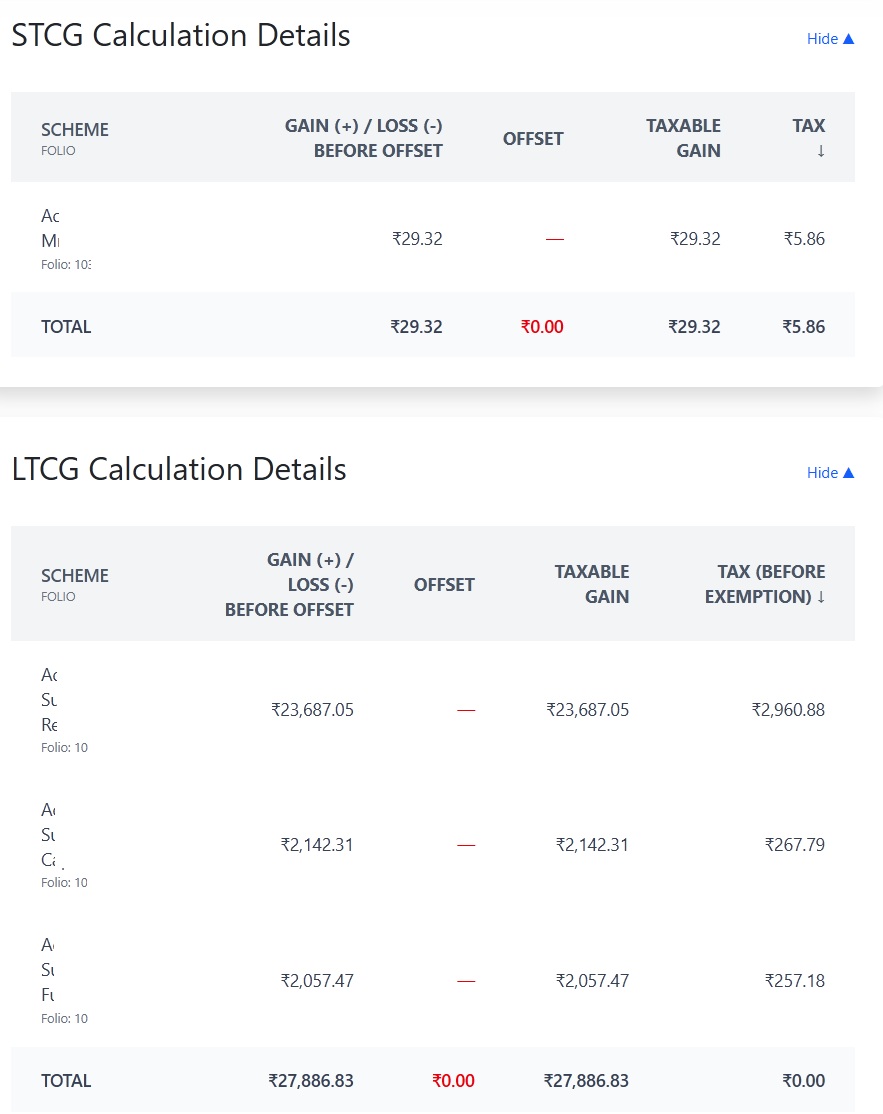
We provide a complete summary across LTCG and STCG, apply Section 112A LTCG offset and even apply capital loss adjustments. We also apply the right tax rates for each fund in the portfolio to give you the tax you need to actually pay. We offer two reports:
Moneyantra Mutual Funds Capital Gains Summary Report
Moneyantra Mutual Funds Capital Gains Details Report
So don’t wait. Generate your Mutual Fund Consolidated Account Statement and get started with Tax Calculation today.
Moneyantra Capita Gains ITR2 Filing support feature
Moneyantra supports Excel exports that will help you file you ITR2 in seconds for mutual fund capital gains. You can read more about the feature here: How to Calculate & File Mutual Fund Capital Gains for FY 2025-26
Frequently Asked Questions (FAQs) on Advance Tax for Mutual Funds
What is the deadline for the last installment of Advance Tax?
For the financial year 2025-26, the deadline to pay 100% of your estimated tax liability is March 15, 2026.
Who needs to pay advance tax on mutual fund gains?
Any investor whose total tax liability (after TDS) exceeds ₹10,000 in a financial year must pay advance tax. This includes gains realised from selling Equity, Debt, or Hybrid mutual funds.
How does Moneyantra help with advance tax calculation?
Moneyantra’s tool processes your Consolidated Account Statement (CAS), applies the First-In-First-Out (FIFO) method, and calculates the exact Short-Term and Long-Term Capital Gains to determine the tax you owe.
What happens if I miss the March 15 deadline?
Delaying payment beyond March 15 attracts interest penalties under Section 234C (1% per month on the shortfall) and Section 234B if 90% of the total tax isn’t paid by March 31.
Are senior citizens exempt from advance tax?
Resident individuals aged 60 or above who do not have any income from ‘Profits and Gains of Business or Profession’ (PGBP) are exempt from paying advance tax.
How do I pay the advance tax once I have calculated the amount?
You can pay online via the Income Tax e-Filing portal using the ‘e-Pay Tax’ facility. Select ‘Challan 280’ and choose ‘(100) Advance Tax’ as the type of payment.
Does the tool handle the new tax rates for FY 2025-26?
Yes, the Moneyantra tool is updated with the latest tax rules, including the 12.5% LTCG rate for equity and the removal of indexation benefits where applicable.