


About: Sayan Sircar (BE/MBA/CFA/FRM) has over 19 years of experience in goal-based investments, portfolio construction, risk/reward simulations and performance analysis. You can read more from Sayan here.
Summary
- Tax Harvesting saves up to ₹15,625/year tax legally under Section 112A
- Calculation of Tax Harvesting is difficult to do by hand or Excel since tax rules are complex
- Moneyantra offers a free and easy-to-use tax harvesting tool that anyone can use
Check How Much Tax I Can Save By Harvesting 👇
Upload CAS into Moneyantra & Save Tax →What is Tax Harvesting and How Can You Save Tax?
Many Indian mutual fund investors don’t realise that they can legally lower the capital gains in their portfolio by doing something very simple called tax harvesting. If you hold funds for more than a year, you can sell and repurchase some units without paying capital gains tax. By doing this, your effective purchase price goes up and you pay less tax when you sell them finally later. This is called Tax Harvesting.
Tax Harvesting is a fully legal (under Section 112A) tax-planning step you do today with your mutual fund portfolio by either selling some units which have profit (“Gain Harvesting”) up to ₹1.25 lakhs without paying tax or booking losses (“Loss Harvesting”) in your existing portfolio (under Section 70) to offset against profits that you already have. That being said, tax harvesting is very difficult to calculate manually / via Excel since you need to account for the First-In First-Out (FIFO) rule for units, adjust for each SIP date and apply it only to equity-oriented funds purchased over a year back.
This is why we built Moneyantra’s free tax harvesting calculator which does all of this in seconds.
How Does Tax Harvesting Save You Tax?
Tax Harvesting is all the more important right now, given that the Indian equity market’s recent returns are fairly low, which presents an excellent opportunity to raise the purchase price of a large number of units at once via tax gain harvesting. Given that the Section 112A exemption was introduced in July 2024 (Union Budget 2024), it remains available for FY 2025-26 until at least 31st March 2025.
Tax harvesting saves you tax in two ways: gain harvesting and loss harvesting.
Tax Gain Harvesting can Save ₹15,625 tax per year
To explain the concept of harvesting simply, we will use this example where you buy the same mutual fund at ₹100 and gain-harvest once, on reaching year 2 at the ₹120 level in reinvest into a similar fund.

| Due date | Advance tax payable |
|---|---|
| 15th June | 15% |
| 15th September | 45% |
| 15th December | 75% |
| 15th March | 100% |
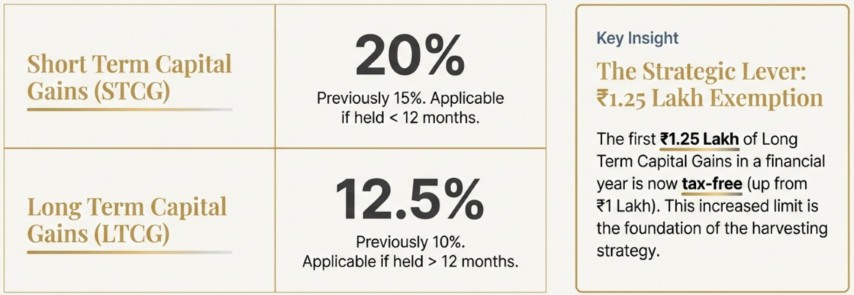
Since the exemption limit on profits (₹20 in the above example) is actually ₹1.25 lakhs with tax calculated at 12.5%, tax harvesting saves you 12.5% of 1.25 lakhs i.e. ₹15,625 tax a year.
Tax Loss Harvesting can Offset Tax Today against Capital Gains You Already Have
Loss harvesting is a simple way to sell your mutual fund units at a loss so that you can reduce tax on profits today or in the future by carrying it forward.
Loss harvesting is best done when you have units which you want to sell off since you are cleaning up your portfolio (no need to buy that fund again) or want to reduce capital gains tax on units you have already sold.
How To Do Tax Harvesting To Save ₹15,625 Capital Gains Tax?
If tax harvesting interests you, and you are wondering if you should do it, then you are at the right place. Moneyantra offers a free tool to calculate tax harvesting (both gain and loss harvesting) which shows:
- which funds you should sell and how much
- just needs you to upload your complete Mutual Fund Statement
- safely applies all the tax rules that make harvesting allowed
You can see how easy it is to use the Moneyantra.com website to do tax harvesting via this YouTube video.
Join 1,000+ investors who have already reviewed their portfolios for free.
Moneyantra Mutual Fund Portfolio Review 👇
Know Best and worst portfolio funds →As an added bonus, Moneyantra even calculates your capital gains tax for any mutual fund you have in your portfolio. This way you can find out how much tax to need to pay before you sell the units. You can also get a report of capital gains tax for mutual funds you have already sold using Moneyantra.
How Is Tax Harvesting a Legal Tax Planning Strategy?
As per Union Budget 2024, Tax Harvesting for Profits or “Tax Gain Harvesting” comes under Section 112A of the Income Tax Act, (cached copy), that allows you to sell shares and units of equity-oriented mutual funds and not have to pay capital gains tax up to ₹1.25 lakhs of profit provided these units sold were purchased at least one year before selling.
A complete list of gain-harvesting eligible funds is here: Mutual Fund Taxation in India: Free Calculator for Capital Gains Tax, Offsetting and Tax Harvesting
For loss harvesting, you can book and offset any capital loss against capital gains under Section 70 like this:
| Capital Loss (CL) |
Offset against STCG? |
Offset against LTCG? |
|---|---|---|
| Short-term (STCL) |
✅ Yes | ✅ Yes |
| Long-term (LTCL) |
❌ No | ✅ Yes |
To do tax harvesting correctly, you need to follow the two main rules of tax harvesting:
- Tax Gain Harvesting: Equity-oriented funds can be sold and up to ₹1.25 lakhs of profit is tax-free in a financial year (April to next March)
- Tax Loss Harvesting: Capital loss in funds can be offset against capital gains
You can apply tax harvesting in many ways:
- Cleaning up (“decluttering”) your portfolio which has too many funds
- Rebalancing your portfolio when you buy a fund (“buy low”) by selling another fund (“sell high”)
- Book gains today so that the purchase price of your units increases and you pay less tax in the future
- Book loss today which you can either offset or carry forward for the next 8 years (using Section 74) provided you file ITR every year
Why Is It Difficult to Do Tax Harvesting Manually?
To do Tax Harvesting correctly, you need to follow some rules that sound simple but are difficult to do without the right tools:
- The units you are selling must be at least one year old since Long-term Capital Gains (LTCG) applies after one year ➡️ Short-term (less than a years old) units have 20% tax without exemption and most mutual funds charge 1% exit load if you sell before one year
- The units are sold using the First-In First-Out (FIFO) rule that is the oldest unsold units are considered to be sold first inside that folio ➡️ You cannot pick and choose units to be sold first
- Each SIP instalment or lump sum purchase that you made will have it’s own purchase date ➡️ To sell, you need to find the oldest unit that is not yet sold and add up from there
- You must be selling units of mutual funds with equity-oriented taxation which includes all equity funds, and hybrid funds with more than 65% in domestic equity or arbitrage positions ➡️ If you sell the wrong fund, you end up paying more tax
This is exactly what the Moneyantra’s tax harvesting tool automates in seconds via a simple screen that looks like this:

Detailed Example: How Tax Harvesting Can Save Tax in a Real Portfolio?
Imagine that you purchased equity mutual funds for ₹5 lakhs two years back and the fund grew to ₹6.25 lakhs (₹1.25 lakhs profit) after year one and to ₹7.5 lakhs (now ₹2.5 lakhs profit) in year two when you finally sold it.
| Description | Strategy A: Buy and Hold (No Harvesting) |
Strategy B: Tax Harvesting (Annual Sell/Buy) |
|---|---|---|
| Purchase price (Cost Basis) |
₹5 lakhs | ₹6.25 lakhs due to harvesting |
| Year 1 Profit | ₹1,25,000 (Unrealized since not sold) |
₹1,25,000 (Realized by Harvesting) |
| Year 1 Tax Paid | ₹0 (No sale made) | ₹0 (Exempt under Section 112A) |
| Year 1 Reinvestment | None | ₹6.25 lakhs into similar fund |
| New Cost Basis | ₹5 lakhs (no change) | ₹6.25 lakhs due to harvesting |
| Year 2 Profit | ₹1,25,000 (Unrealized) | ₹1,25,000 (Realized) |
| Sale Value in Year 2 |
₹7.5 lakhs | ₹7.5 lakhs (same) |
| Total Gain Realized | ₹2,50,000 (Sold only in Year 2) | ₹1,25,000 (₹1.25 lakhs booked last year) |
| Exemption Used | ₹1,25,000 (Only 1 year’s limit) | ₹2,50,000 (2Y of limits used) |
| Taxable Profit | ₹ 1,25,000 | ₹ 0 |
| Total Tax @ 12.5% | ₹ 15,625 | ₹ 0 |
| Final Result | Paid ₹15,625 Tax | Saved ₹15,625 Tax via Tax Harvesting |
This means that by harvesting your gains after Year 1, you effectively increased your purchase cost from ₹5 lakhs to ₹6.25 lakhs. That is why if you keep on harvesting every year, you can keep on reducing your final LTCG tax by ₹15,625 per year.
What To Do Once You Have Done Tax Harvesting?
The exact units, dates, and tax classification depend on FIFO and folio-level data, which the Moneyantra tool calculates automatically. Once done, the next step after tax harvesting depends on why you did tax harvesting:
- if you planned to clean up or rebalance your portfolio, you can reinvest the money in new / alternative funds
- if you planned to offset profits using losses, you can reinvest in funds that are doing well that you did not yet have
So don’t wait. Generate your Mutual Fund Consolidated Account Statement and get started with Tax Harvesting today.
Frequently Asked Questions (FAQs) on Tax Harvesting
What is tax gain harvesting and how does it work?
Tax Harvesting is a strategy where investors sell appreciated shares or mutual funds to realise profits up to the annual tax-free limit and simultaneously reinvest the proceeds to maintain market exposure.
How much tax can I legally save using Section 112A?
Under current laws effective after July 23, 2024, Long-Term Capital Gains (LTCG) are taxed at 12.5% for amounts exceeding the ₹1.25 lakh annual exemption. By harvesting gains up to this limit every year, you can save ₹15,625 (12.5% of ₹1.25 lakhs) in taxes annually.
Does tax harvesting impact the power of compounding?
Tax harvesting does not hinder compounding as long as you reinvest the proceeds immediately, because your money remains in the market. If you just harvest without reinvestment, you will lose compounding benefits
How to do tax harvesting easily?
Use the tax harvesting tool on the moneyantra.com website to do tax harvesting in seconds using your mutual fund portfolio consolidated account statement (CAS).
How difficult is it to do tax harvesting?
Tax harvesting requires you to apply the FIFO rule and choose only equity-oriented fund units that are a year old and not yet sold. Without the right tools, this tax harvesting is difficult. This is why we have built the tax harvesting tool on the moneyantra.com website which makes this calculation of tax harvesting very easy.
How much cash do I need to do tax harvesting?
You don’t need any free cash to do tax harvesting if you simply do a switch transaction. Otherwise, you can wait for the cash to come and then reinvest. Alternatively, you can do harvesting based on the amount of cash you have in your account and repeat the cycle multiple times. A pro-tip is to place the buy order 1-2 days before the sell order since units take that long to get allocated. This way it is likely to get buy and sell NAV for the same calendar date
Which fund should I purchase while tax harvesting?
India does not have a wash sale rule. However, selling and immediately repurchasing of units in the exact same fund is not a good idea. Instead move the harvested amount into a similar fund of the same or another AMC
Is there a free tool to calculate tax harvesting for mutual funds?
Yes. Moneyantra offers a free tax harvesting tool that analyses your mutual fund statement and shows how much LTCG tax you can legally save, using FIFO and current tax rules.
How do I apply tax harvesting to my SIP investments?
For SIPs and mutual funds, the First-In, First-Out (FIFO) rule applies, meaning the oldest units are considered sold first. The tax harvesting tool in moneyantra.com website applies the FIFO rule to calculate your tax harvesting correctly.